
Latest
Traders shut down shops, embark on protest of inflation in Ghana

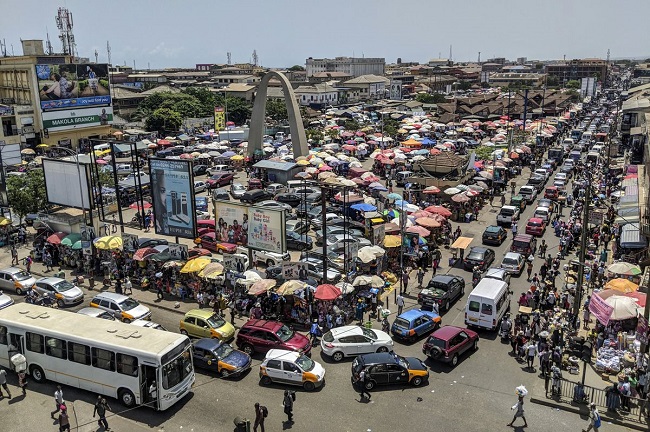
Traders in Accra, Ghana, on Wednesday locked up their stores, closing down businesses to commence three days of protest for the rising inflation and costs of living in country.
The mass protest caused gridlock in the Central Business District of Accra.
President Nana Akufo-Addo is under pressure over his economic management after reversing his position and entering talks with the IMF over a $3-billion loan to shore up public finances.
Ghana faces a high debt load and inflation at a historic high of 37 percent in September, while the local cedi currency has plummeted against the US dollar.
Kwesi Amoah, a spare parts dealer at Abossey Okai, a suburb of Accra, told AFP traders no longer issued pro-forma invoices because prices change within a day, sometimes within hours.
“We understand these are tough times all over the world, but our neighbours in Cote d’Ivoire and Burkina Faso are not suffering like us,” he said.
The Ghana Union of Traders Association (GUTA) union said the move sent a signal to the government that they were frustrated over poor economic management.
GUTA president Joseph Obeng said the protest was just a “pinch” for the government to quickly fix the economy to save Ghanaian businesses.
“It’s obvious that we cannot contain this any longer as it’s increasingly getting unbearable,” he said.
The Council of State, a constitutionally mandated advisory body for the president, failed in an attempt to persuade traders to call off their strike on Tuesday.
The government has so far not commented on the protest.
“Akufo-Addo has disappointed us. We voted for change and (a) better way of life,” Doris Andoh, a 37-year-old trader in the Central Business District, told AFP.
“I have four children, as we speak, two of them are home because I cannot pay school fees. I joined in this protest to let the government know that we are suffering.”
On Monday, Akufo-Addo was booed by scores of traders in the Ashanti Region, the stronghold of his governing New Patriotic Party (NPP), on his way to inspect some government projects.
The traders said they were voicing their displeasure with the economic situation.
Ghana’s central bank has increased its benchmark lending rate by 10 percentage points this year to 24.5 percent in a bid to tame price growth. But that increased borrowing costs for traders.
The International Monetary Fund has started talks with Ghana over a deal and last month IMF officials said they expected to reach an agreement before the end of the year.
Source: Channels TV


-
 Latest6 days ago
Full List: Meet the 2026 Nobel Prize winners across six categories
-

 Football6 days ago
Premier League Matchweek 7: Five Fixtures That Could Shape the Weekend
-

 Business4 days ago
Dangote Refinery IPO: 70% Subscription claim meets fourfold demand assertion as investors seek clarity
-

 Latest5 days ago
Umahi defends Lagos-Calabar highway route changes amid public outcry
-
Business5 days ago
Dangote Refinery IPO Extension: Was the 70% subscription report overhyped?
-

 Latest3 days ago
UCTH faces morgue crisis as 50 unclaimed corpses await mass burial
-
 Featured5 days ago
El-Rufai, ADC governorship candidate’s court appearance puts Kaduna opposition politics in focus
-
 Business3 days ago
BREAKING: Nigeria’s Inflation Rate Drops to 14.63% in September