
Latest
Jonathan’s silence fuels speculation over 2027 presidency ambition

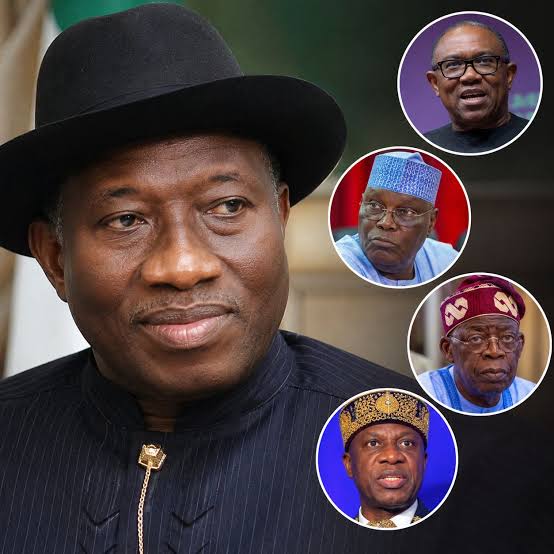
The continued silence of former President Goodluck Jonathan over his purported adoption as a presidential candidate by a faction of the Peoples Democratic Party (PDP) has intensified speculation about his political future and raised fresh doubts about whether he intends to challenge President Bola Tinubu in the 2027 general election.
Although a PDP faction led by Tanimu Turaki has reportedly screened, adopted and ratified Jonathan as its presidential candidate, the former Nigerian leader has neither accepted the nomination nor publicly indicated any interest in returning to active partisan politics.
The development has sparked widespread debate within political circles, with allies and close associates of the former president insisting that there is currently no evidence to suggest he is preparing a presidential bid.
According to reports, individuals familiar with Jonathan’s political disposition argue that if he were genuinely interested in contesting the 2027 election, he would have already begun consultations with political stakeholders, openly aligned himself with a political platform and actively participated in activities leading to his emergence as a candidate.
READ ALSO: 2027: The real reason Jonathan hasn’t accepted PDP ticket—Umar Sani
The associates also pointed out that Jonathan neither purchased nor submitted a nomination form and was not involved in any screening process conducted by the PDP faction that announced his adoption.
One source described the latest development as part of a recurring pattern in Nigerian politics, where Jonathan’s name is repeatedly linked to presidential contests during election cycles despite the absence of any formal declaration from the former president himself.
According to the source, Jonathan has not communicated any intention to seek elective office in 2027 and has not engaged in the political groundwork typically associated with serious presidential aspirants.
The debate comes shortly after a Federal High Court in Abuja reaffirmed Jonathan’s constitutional eligibility to contest the presidency, dismissing a suit that sought to prevent him from participating in the 2027 election.
While the court ruling settled legal questions surrounding his eligibility, political observers note that it did little to clarify whether the former president has any desire to return to Aso Rock.
For now, Jonathan’s actions appear to suggest caution rather than political ambition.
Unlike several politicians widely believed to be positioning themselves for the 2027 presidential race, the former president has not launched consultations, built a campaign structure, announced a political agenda or publicly addressed the endorsement by the PDP faction.
His silence has created room for varying interpretations among supporters, party members and political analysts.
Backers of the Turaki-led faction argue that Jonathan’s reserved approach should not be interpreted as a lack of interest. They contend that throughout his political career, he has often avoided aggressive political maneuvering and preferred to allow events to evolve naturally around him.
Others, however, believe his refusal to publicly embrace the nomination reflects a desire to preserve the statesman image he has cultivated since leaving office in 2015.
Since conceding defeat to former President Muhammadu Buhari in a move widely praised as a milestone for Nigeria’s democracy, Jonathan has largely distanced himself from partisan politics.
Instead, he has focused on international democracy advocacy, election observation missions and conflict-resolution initiatives across Africa through various diplomatic and governance platforms.
Political analysts note that a return to frontline politics could expose Jonathan to renewed scrutiny over key issues that defined his administration, including security challenges, corruption allegations and internal divisions that affected the PDP during his tenure.
Beyond the question of Jonathan’s personal ambitions, analysts say the controversy highlights the continuing leadership and structural crisis within the PDP ahead of the 2027 elections.
The opposition party remains divided among competing factions, with the group that endorsed Jonathan lacking official recognition from the Independent National Electoral Commission (INEC).
That reality has raised questions about the practical significance of the endorsement and whether it represents a genuine presidential project capable of gaining national traction or merely another chapter in the ongoing struggle for control of the opposition party.
As political realignments continue ahead of the next election cycle, observers say Jonathan’s next move—or continued silence—could prove decisive in determining whether the former president remains a respected elder statesman on the sidelines or re-emerges as a major player in Nigeria’s increasingly complex political landscape.


-
 Latest7 days ago
Israel marks 3 years since October 7 Hamas attack amid Gaza strikes, election debate
-

 Energy6 days ago
Fuel Battle: Dangote, marketers and government clash over petrol imports
-

 Energy1 week ago
Petrol, diesel prices rise 86% in 2026 as costs hit fresh highs
-

 Football1 week ago
Nigeria’s World Cup exit under spotlight as FIFA’s DR Congo files emerge
-

 Latest1 day ago
Full List: Meet the 2026 Nobel Prize winners across six categories
-

 Latest1 week ago
US Court set to rule on release of FBI, DEA records on Tinubu
-

 Business1 week ago
Nigerian investors at a crossroads as fixed-income yields slide
-

 Latest1 week ago
Oyo APC crisis deepens as Oluyole reconciliation meeting ends in brawl