
Business
NCC applauds Bosun Tijani’s drive to equip Nigerian girls with digital skills

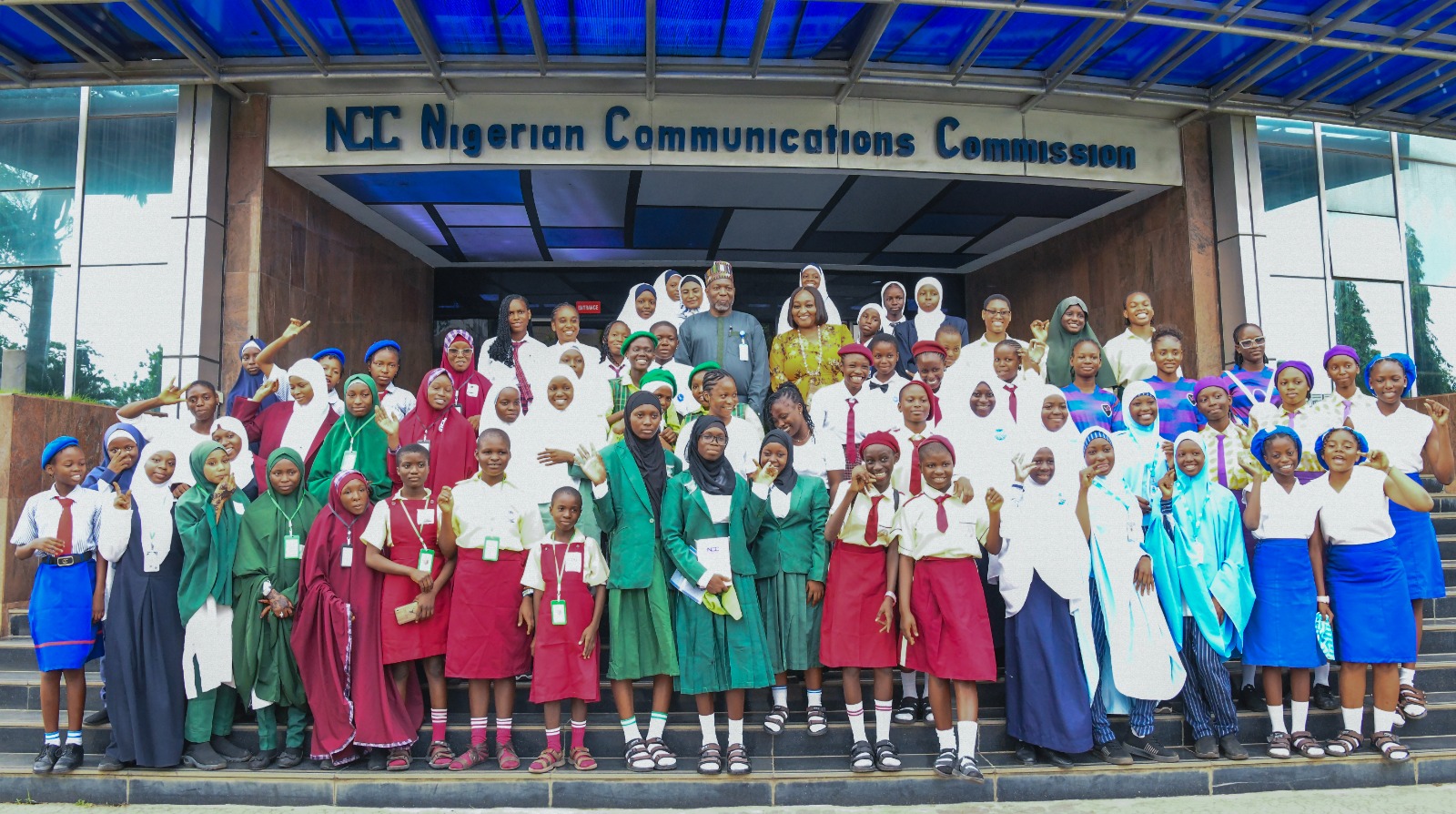
The Nigerian Communications Commission (NCC) has lauded the Minister of Communications, Innovation and Digital Economy, Bosun Tijani, for spearheading initiatives aimed at empowering young Nigerians—particularly girls—with critical digital knowledge and technology skills needed to thrive in the digital age.
The commendation came as the Commission hosted 185 contestants of the 2026 National Girls in ICT (NG-ICT) Competition at the National Communications Museum in Abuja.
The educational tour formed part of activities organised under the National Girls in ICT Programme, a flagship initiative designed to bridge the gender gap in the technology sector by exposing young girls to digital innovation, mentorship and career opportunities in Information and Communication Technology (ICT).
Speaking during the tour, the Executive Vice Chairman of the NCC, Aminu Maida, represented by the Director of Research and Development, Babagana Digima, described the programme as a strategic intervention that aligns with the Commission’s commitment to advancing digital literacy and inclusion across Nigeria.
The 185 participants, selected from across the country’s geopolitical zones by the Ministry of Communications, Innovation and Digital Economy, are competing in a programme designed to encourage greater female participation in ICT and other Science, Technology, Engineering and Mathematics (STEM) disciplines.
According to Maida, the museum tour was carefully designed to connect the younger generation with the rich history of Nigeria’s telecommunications industry, providing them with a deeper understanding of how communication technologies have evolved from rudimentary systems to the sophisticated digital infrastructure of today.
He noted that exposing students to the historical development of telecommunications would not only deepen their appreciation of the industry’s transformation but also inspire them to become active contributors to the future of digital innovation in Nigeria.
READ ALSO: NCC unveils new MVNO rules to boost competition, consumer choice in telecom sector
“The whole idea behind this is that we are looking at the younger generation. We want to show them what communication is all about. This place is a museum meant to preserve the history of what has gone before and to keep the artefacts, ensuring that people see the evolution from the postal system to telegraphy, from analogue systems to the digital era,” he said.
He added that understanding the journey of technological advancement could stimulate curiosity among young people and encourage them to imagine and shape the next phase of Nigeria’s digital future.
During the guided tour, NCC officials took the students through a comprehensive exhibition of historical artefacts and milestones that have defined the country’s communications landscape over more than a century.
Participants learned about the origins of telecommunications in Nigeria, dating back to 1886 when the colonial administration established the first communication facilities primarily to support governance and administrative functions.
The students were also introduced to the history of telegraph services that connected Lagos to other parts of West Africa and Europe through submarine cable systems, laying the foundation for modern communication networks.
The tour further highlighted the state of telecommunications at Nigeria’s independence in 1960, when the country had just 18,724 telephone lines serving a population estimated at 40 million people. Participants were briefed on the post-independence development plans that sought to expand communication services, as well as the roles played by the former Department of Posts and Telecommunications (P&T), Nigerian External Telecommunications (NET) Limited and the establishment of the Nigerian Telecommunications Limited (NITEL) in 1985.
One of the major attractions of the visit was the display of rare historical artefacts preserved at the National Communications Museum. The exhibits included a Post Office Counter dating back to 1852, Sorting Racks introduced to Lagos in the same year, the historic Grand “T” Key used at the Lagos Post Office in the nineteenth century, leather mail bags from 1863, Drop Bag fittings from the late twentieth century, a 511A Letter Scale, an Improved Dynamometer Scale from the 1920s, telegram machines, Teleprinter T100 equipment, Cordless PBX systems and early Digital Card Phones.
The NCC said the initiative underscores the Federal Government’s commitment to nurturing a new generation of digitally skilled innovators and leaders who can drive Nigeria’s growing digital economy while promoting greater gender inclusion in the technology ecosystem.


-

 Business5 days ago
CBN reduces MPR by 350bps to 23% in major monetary policy shift
-

 Business7 days ago
Jetour takes T1 adventure SUV experience to Abuja, targets growing Nigerian market
-

 Football4 days ago
Saka: England still carry World Cup scar
-

 Comments and Issues5 days ago
Sometimes, goodwill finds us through the people we love
-

 Football7 days ago
Nigeria vs Colombia: Falconets battle for U-20 World Cup semi-final ticket
-

 Football1 week ago
Breaking:Brighton shocks Arsenal 3-0 as Gunners’ perfect start comes crashing down
-

 Comments and Issues6 days ago
Peter Obi and the Pensioners’ Testimony
-

 Business7 days ago
NMDPRA moves against petrol price gouging as pump prices rise to N1,450