
Business
Nigeria’s economy recovering from crisis, entering growth phase — NRS


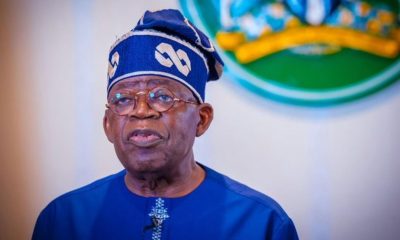
The Nigeria Revenue Service (NRS) says Nigeria’s economy is undergoing a significant recovery, with key economic indicators pointing to improved stability and stronger growth following a series of reforms introduced by President Bola Tinubu’s administration.
The revenue agency made the assessment in an internal report, attributing the changing economic outlook to what it described as Tinubu’s “economic management acumen and doggedness” in implementing reforms under his Renewed Hope Agenda.
According to the NRS, the country has moved from a period of severe macroeconomic instability to what it described as a “more stable and increasingly resilient footing.”
“The Nigerian economy has moved decisively from acute macroeconomic distress toward a more stable and increasingly resilient footing,” the report stated.
Four major distortions inherited
The NRS said the Tinubu administration inherited four major economic distortions that had reinforced one another and weakened the country’s finances.
They include a fiscally unsustainable fuel subsidy regime, an opaque foreign exchange system that discouraged investment, an underperforming oil sector and a tax base that remained significantly below its potential.
The agency said the initial implementation of reforms came with considerable economic hardship but argued that the effects of the measures are now becoming evident in several areas.
It pointed to declining inflation, an improvement in the balance of payments, increased tax revenues, higher oil production and Nigeria’s emergence as a net exporter of petroleum products as evidence of the recovery.
READ ALSO; Presidency defends Tinubu’s economic reforms, rebuts Atiku’s criticism
The NRS also noted that the minimum wage has doubled between 2023 and 2026.
It further cited estimates by the United Nations Children’s Fund (UNICEF) indicating that the number of out-of-school children had declined from about 20 million to 18.3 million following government policies and incentives.
Nigeria becomes net petroleum products exporter
The revenue service attributed Nigeria’s transition from a long-standing dependence on imported petroleum products to net exports partly to the government’s naira-for-crude arrangement with the Dangote Refinery and other domestic refineries.
“The government’s naira-for-crude arrangement with Dangote Refinery and other local refineries has ensured that Nigeria has become a net exporter of petroleum products after decades of being net importers,” the report said.
The agency noted that Ghana had recently indicated plans to pursue a similar policy in its oil sector.
It also said domestic crude oil production had increased from approximately 1.2–1.3 million barrels per day in 2023 to 1.73 million barrels per day by July 2026, representing about 104 percent of Nigeria’s OPEC quota.
Stock market capitalisation hits N161trn
The NRS said improved economic stability had also translated into stronger performance in the capital market.
According to the report, the market capitalisation of the Nigerian Exchange (NGX) increased from N30.36 trillion in 2023 to approximately N161 trillion in 2026.
It attributed the rally partly to improved macroeconomic credibility, recapitalisation of the banking sector and increased participation by domestic institutional investors.
The agency said the growth in the market had created wealth for millions of Nigerians who invest in equities.
Tax revenue more than doubles
The NRS said government tax collections had more than doubled from N12.3 trillion in 2023 to N27.1 trillion as of July 2026.
READ ALSO; Capital market defies economic headwinds as investors bet on corporate earnings, reforms
It attributed the increase to the digitisation of tax administration, the introduction of four new tax reform laws, the transformation of the revenue service and an executive order aimed at closing loopholes within the tax system.
The agency also said Nigeria’s debt-to-GDP ratio had begun to decline despite an increase in the country’s nominal debt stock.
According to the report, economic growth improved from 2.74 percent in 2023 to 3.8 percent in the first half of 2026, while external reserves rose from $3.99 billion in 2023 to a 17-year high of $51.9 billion by July 2026.
The balance of payments also moved from a $3.34 billion deficit to a $2.38 billion surplus in the first quarter of 2026.
Trade surplus rises to N7.55trn
The NRS said Nigeria’s trade position had also recorded a major turnaround.
It reported that the country moved from a marginal trade surplus of N44.7 billion to a N7.55 trillion surplus in the first quarter of 2026.
The agency said the composition of exports was also beginning to change, although crude oil remained the dominant export.
Exports of other oil products increased by 51 percent year-on-year to N6.78 trillion during Q1 2026, according to the report.
Capital importation also increased substantially, rising from $3.9 billion in 2023 to $23.22 billion in 2025. The NRS said inflows reached $10.37 billion in the first quarter of 2026 alone.
It said foreign portfolio investment had been particularly strong, while foreign direct investment had also improved.
CNG conversions top 100,000 vehicles
The revenue service also highlighted developments in the compressed natural gas (CNG) sector as part of the administration’s efforts to reduce dependence on petrol and diesel.
According to the report, more than 100,000 vehicles had been converted to CNG by 2026, with more than $2 billion in investments reportedly mobilised and over 10,000 jobs created.
The NRS estimated that CNG could reduce running costs by between 40 and 60 percent compared with petrol.
For commercial drivers, it said some monthly fuel expenses had reportedly fallen from about N50,000 to N18,000 after vehicle conversion.
Debt burden declines relative to GDP
The revenue agency acknowledged that Nigeria’s nominal debt stock increased from N87.4 trillion in 2023 to N159.28 trillion in late 2025.
However, it argued that debt-to-GDP was a more meaningful measure of the country’s debt burden.
According to the report, the ratio declined from 38 percent in 2023 to 35.5 percent in 2025 and further to 32.3 percent in 2026.
The NRS described the decline as the first sustained reduction in more than a decade.
It also said debt servicing as a proportion of government revenue had declined from 68 percent to a projected 53 percent, citing the International Monetary Fund.


-
 Latest1 week ago
Israel marks 3 years since October 7 Hamas attack amid Gaza strikes, election debate
-

 Energy1 week ago
Fuel Battle: Dangote, marketers and government clash over petrol imports
-

 Latest2 days ago
Full List: Meet the 2026 Nobel Prize winners across six categories
-
 Latest1 week ago
US Court set to rule on release of FBI, DEA records on Tinubu
-
 Featured6 days ago
103 Million Voters: What does INEC’s new register say about Nigeria’s population?
-

 Business1 week ago
Nigerian investors at a crossroads as fixed-income yields slide
-

 Business1 week ago
Nigerian startup 3650HQ moves to cut rising WhatsApp costs for businesses
-

 Latest1 week ago
Oyo APC crisis deepens as Oluyole reconciliation meeting ends in brawl