
Latest
APC primary figures: Genuine grassroots support or party machinery at work?


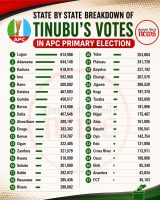
The overwhelming state-by-state figures recorded by President Bola Ahmed Tinubu in the presidential primary of the All Progressives Congress have reignited debate over the true meaning of political dominance within Nigeria’s party system, with analysts divided on whether the numbers reflect genuine grassroots popularity or the strength of entrenched party machinery.
The primary results, which showed commanding margins across several states, particularly in Lagos, Kano, Kaduna, Adamawa and Imo, have been interpreted by supporters as evidence of Tinubu’s enduring influence and national political reach.
Within APC circles, the outcome is being projected as proof that the president remains firmly in control of the ruling party structure ahead of the 2027 general elections.
Party loyalists argue that the widespread support across multiple geopolitical zones demonstrates a stable internal coalition capable of sustaining the APC’s electoral fortunes.
However, critics and political observers say the scale of the victory has once again raised familiar questions surrounding the credibility and transparency of delegate-based party primaries in Nigeria.
The discussion intensified following renewed public scrutiny over how delegate figures are generated, counted and announced during internal party contests.
Over the years, several party primaries across Nigeria have attracted criticism after videos emerged showing controversial accreditation methods, voice-vote systems and delegate counts that some observers claimed did not align with visible participation on the ground.
READ ALSO: APC primary turns violent in Ondo Central, Senator escapes assassination attempt
For many analysts, the latest APC figures reveal less about public electoral popularity and more about the effectiveness of internal political structures.
Political analyst and public affairs commentator, Jide Ojo, said party primaries in Nigeria are largely controlled by established networks of influence rather than mass voter participation.
“Primaries are fundamentally different from general elections because they are controlled by a limited number of delegates who are often influenced by governors, party leaders and existing power blocs,” he explained.
According to him, commanding numbers in a party primary may indicate organizational dominance, but they do not automatically translate into nationwide electoral acceptance.
Another analyst, Kabiru Adamu, noted that Tinubu’s strong showing reflects the president’s continued grip on APC structures nationwide.
“What these results show is that the president still commands significant loyalty within the party establishment. Governors, legislators and party executives remain central to how delegates vote,” he said.
He added, however, that the political climate ahead of 2027 could be significantly different from the environment within the party.
“A primary election rewards structure and internal alliances. A general election requires broader public approval, economic confidence and voter enthusiasm,” he stated.
Observers also point to the geographical spread of the results as an indication of where the APC’s strongest political machinery currently exists.
States such as Lagos and Kano have historically served as major power centres within the ruling party, while strong numbers from parts of the South-East and North-East suggest continued efforts by the APC to deepen its influence beyond traditional strongholds.
Yet opposition voices insist that internal party victories should not be mistaken for guaranteed electoral success.
Critics argue that Nigeria’s general elections involve millions of registered voters with diverse concerns ranging from insecurity and inflation to unemployment and governance performance — factors that extend beyond party delegate loyalty.
Some civil society observers further contend that the credibility of internal party democracy remains a major issue in Nigeria’s political process.
They warn that heavily controlled primaries could discourage internal competition and weaken confidence among younger politicians and grassroots members seeking greater transparency in candidate selection.
Despite the controversy, APC supporters maintain that Tinubu’s dominance in the primary reflects strategic political organization and years of coalition building across the country.
For them, the figures reinforce the president’s position as the central force within the ruling party ahead of what is expected to be another fiercely contested electoral cycle.
As political alignments continue to shift toward 2027, analysts say the bigger question may not simply be the scale of Tinubu’s primary victory, but whether the APC can convert internal party strength into broad voter support nationwide when Nigerians eventually head to the polls.


-
 Latest6 days ago
Israel marks 3 years since October 7 Hamas attack amid Gaza strikes, election debate
-

 Energy6 days ago
Fuel Battle: Dangote, marketers and government clash over petrol imports
-

 Energy7 days ago
Petrol, diesel prices rise 86% in 2026 as costs hit fresh highs
-

 Energy1 week ago
Has Iran lost control of the Strait of Hormuz? Oil flows rebound as war disruptions persist
-

 Football6 days ago
Nigeria’s World Cup exit under spotlight as FIFA’s DR Congo files emerge
-

 Latest6 days ago
US Court set to rule on release of FBI, DEA records on Tinubu
-

 Business6 days ago
Nigerian investors at a crossroads as fixed-income yields slide
-

 Business1 week ago
LoveWorld Trade and Investment Forum to Convene Business Leaders in Accra