
News
Buhari, Malami sue National Assembly over section 84(12) of Electoral Act

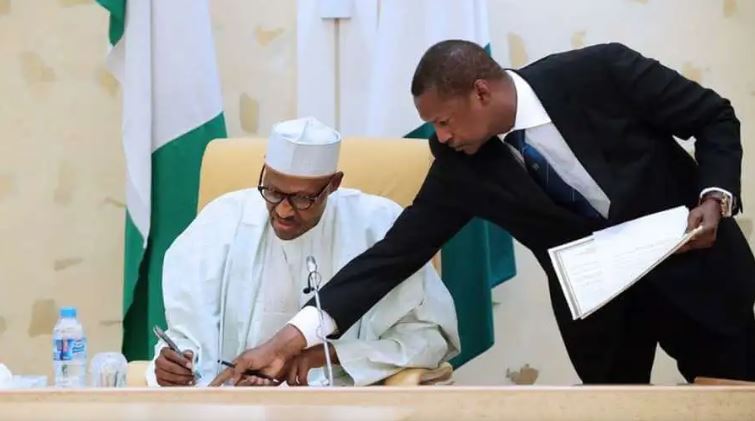
President Muhammadu Buhari, in collaboration with the Attorney-General of the Federation (AGF) and Minister of Justice, Abubakar Malami SAN, have sued the National Assembly at the Supreme Court, seeking interpretation of Section 84(12) of the Electoral Amendment Act 2022. President Buhari and Malami filed the suit on April 29 solely against the National Assembly, requesting the Supreme Court to nullify and expunge Section 84(12) of the Electoral Act, arguing that the section is inconsistent with the nation’s Constitution.
The President and the Justice Minister in the suit argued that Section 84 (12) of the Electoral (Amendment) Act, 2022 is inconsistent with the provisions of Sections 42, 65, 66, 106, 107, 131, 137, 147, 151, 177, 182, 192 and 196 of the Constitution of Federal Republic of Nigeria, 1999, (as amended), as well as Article 2 of the African Charter on Human and People and Peoples Rights.
They declared that the Constitution already provides qualification and disqualification for the offices of the President and Vice President, Governor and Deputy Governor, Senate and House of Representatives, House of Assembly, Ministers, Commissioners, and Special Advisers.
They demanded the court to issue: “A declaration that the joint and combined reading of Sections 65, 66, 106, 107, 131, 137, 147, 151, 177, 182, 192 and 196 of the Constitution of the Federal Republic of Nigeria, 1999, (as amended); the provision of Section 84 (12) of the Electoral Act, 2022, which also ignores Section 84(3) of the same Act, is an additional qualifying and/or disqualifying factors for the National Assembly, House of Assembly, Gubernatorial and Presidential elections as enshrined in the said constitution, hence unconstitutional, unlawful, null and void.”
The National Assembly in a counter-affidavit by counsel to the federal legislature, Kayode Ajulo, argued that the Supreme Court cannot be invoked to amend the provision of any law validity made by lawmakers in the exercise of their legislative powers as granted by the Constitution. The National Assembly requested the Supreme Court to strike out the suit.
The federal legislature insisted that the 1999 Constitution, as amended gave the National Assembly the power to make laws for good governance in Nigeria.


-

 Latest7 days ago
US Immigration fees rise from October 16 as USCIS announces new charges
-
 Latest2 days ago
Israel marks 3 years since October 7 Hamas attack amid Gaza strikes, election debate
-

 Business6 days ago
Nigeria’s $55bn reserves raise fresh questions over naira value
-

 Health6 days ago
Florida sues Pfizer over deceptive COVID-19 vaccine marketing
-

 Business1 week ago
Tuoyo Erikowa wins digital marketing personality of the Year at 2026 EDGE awards
-

 Crime6 days ago
From camp to captivity: How kidnappers now target NYSC Corps members on highways
-

 Featured7 days ago
2027: Can Nigeria’s opposition still unite behind a single presidential candidate?
-

 Crime6 days ago
Fulani Militia leader linked to Christian killings arrested in Plateau