
Featured
Inside Nigeria’s Power Shift: How retired generals, top police chiefs are rewriting the political playbook

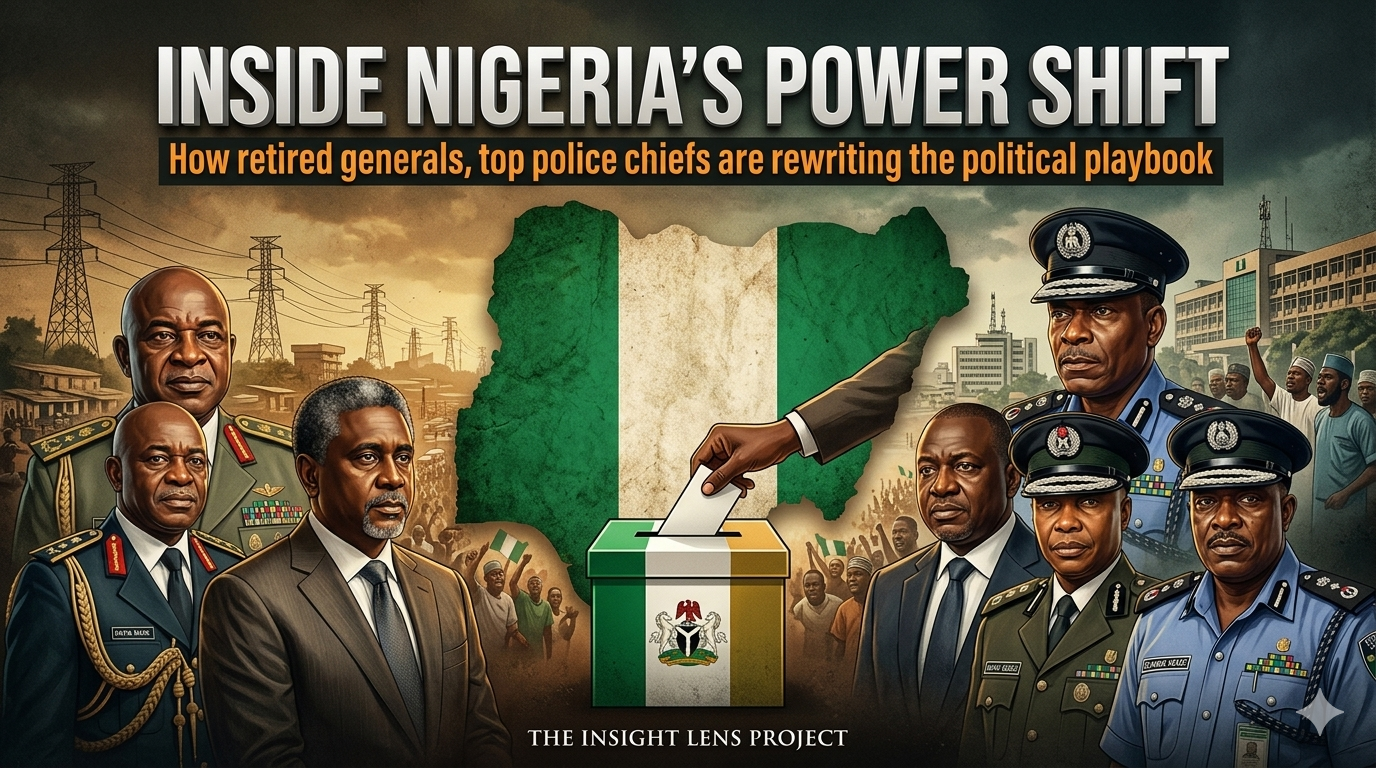
A quiet but steadily expanding transformation is reshaping Nigeria’s political landscape, retired senior police officers and military generals are increasingly stepping out of uniform and into the political arena, where they emerge as candidates, power brokers, and influential actors within party structures.
From former Inspectors-General of Police (IGPs) to Deputy Inspectors-General (DIGs), Assistant Inspectors-General (AIGs), Commissioners of Police, and senior military commanders, the transition from security service into partisan politics has become a defining and controversial feature of Nigeria’s post-retirement elite pathway.
While supporters describe it as the natural continuation of public service, critics argue that it raises deeper questions about how power, influence, and access are accumulated during years in uniform and how those advantages are later deployed in politics.
The Growing Police-to-Politics Pipeline
In recent election cycles, several former top police officers have entered governorship races or assumed politically connected roles shortly after retirement.
Among the most prominent are Abubakar Mohammed Adamu, former Inspector-General of Police (2019–2021), and Usman Alkali Baba, who served as IGP from 2021 to 2023. Both reportedly pursued governorship ambitions under the All Progressives Congress (APC) in Nasarawa and Yobe States respectively after leaving office.
Former Lagos State Commissioner of Police, Fatai Owoseni, also moved into partisan politics in Oyo State through the Accord Party governorship process before later withdrawing amid internal party disagreements.
Beyond these high-profile cases, other former police chiefs have remained active in governance, advisory roles, and party structures. Additional Retired Police Officers in Politics and Public Roles:
- Suleiman Abba (Ex-IGP)
Former Inspector-General of Police (2014–2015); later held senior public service and politically connected administrative roles. - Solomon Arase (Ex-IGP)
Former Inspector-General of Police (2015–2016); served as Chairman of the Police Service Commission (2023–2025), a strategic federal appointment often viewed as politically sensitive. - Mike Okiro (Ex-IGP)
Former Inspector-General of Police (2007–2009); later chaired the Police Service Commission and has remained active in political consultations. - Hafiz Ringim (Ex-IGP)
Former Inspector-General of Police (2010–2012); linked in reports to advisory and politically adjacent engagements after retirement.
At lower levels, numerous DIGs, AIGs, and Commissioners of Police have also contested elections or taken party leadership roles, particularly at state level, often with limited national attention.
The Military’s Enduring Political Footprint
Nigeria’s military establishment has long maintained a strong presence in politics, a legacy that continues in the democratic era through retired officers entering elective office and political strategy roles.
Several former military officers have become prominent political actors across governance and party structures.
Notable figures include:
- Theophilus Bamigboye – former Military Administrator of Osun and Bauchi States; later contested governorship elections in Kwara State
- Sani Bello – retired military officer and influential political actor in Niger State politics
- Jeremiah Useni – retired Lieutenant General; former Minister and later senatorial and governorship aspirant
- David Mark – former military officer who rose to Senate President and became a major political figure
- Aliyu Gusau – retired General; served multiple times as Defence Minister and National Security Adviser
- Sambo Dasuki – retired Colonel; later National Security Adviser and politically influential figure
A Pattern Built on Power, Networks, and Access
Political analysts say the movement of retired security chiefs into politics reflects more than personal ambition, it highlights structural advantages accumulated during years of service in sensitive national institutions.
These include extensive institutional and political networks, national recognition and public visibility, deep access to security and administrative systems, and strong connections within elite political circles.
However, critics and some public commentators argue that these advantages also raise uncomfortable questions about how influence is built and sustained within Nigeria’s security and governance architecture, particularly in a system where serving personnel frequently raise concerns about welfare, logistics, and resource constraints.
Some observers suggest that these realities fuel public suspicion that the same structures that govern security operations may also shape post-retirement political positioning and access to influence.
Despite their advantages, the trend has triggered sustained public debate over fairness, access, and political financing in Nigeria.
At the centre of the discussion is the high cost of elections, where nomination forms, campaign logistics, delegate mobilization, and media strategies require substantial financial resources, often limiting meaningful participation to wealthy or well-connected individuals.
This has raised questions among citizens about how former public servants are able to finance expensive political ambitions shortly after retirement.
While no formal allegations of wrongdoing have been proven against any of the individuals mentioned, critics argue that the pattern reflects broader concerns about transparency in political financing and the privileges associated with elite public service.
Governance experts warn that the increasing participation of retired police and military officers in partisan politics may blur the traditional boundary between security institutions and democratic governance.
Others argue that their experience in intelligence, administration, and crisis management could strengthen governance, particularly in addressing Nigeria’s persistent security challenges.
As Nigeria’s political environment becomes more competitive and capital-intensive, analysts expect more retired senior security officers to enter partisan politics in future election cycles.
The trend continues to raise broader questions about power, privilege, and the evolving relationship between Nigeria’s security establishment and its democratic institutions.


-
 Latest6 days ago
Israel marks 3 years since October 7 Hamas attack amid Gaza strikes, election debate
-

 Energy6 days ago
Fuel Battle: Dangote, marketers and government clash over petrol imports
-

 Energy1 week ago
Petrol, diesel prices rise 86% in 2026 as costs hit fresh highs
-

 Football7 days ago
Nigeria’s World Cup exit under spotlight as FIFA’s DR Congo files emerge
-
 Energy1 week ago
Has Iran lost control of the Strait of Hormuz? Oil flows rebound as war disruptions persist
-

 Latest7 days ago
US Court set to rule on release of FBI, DEA records on Tinubu
-

 Latest19 hours ago
Full List: Meet the 2026 Nobel Prize winners across six categories
-
 Business7 days ago
Nigerian investors at a crossroads as fixed-income yields slide