
Business
Lagos leads as States’ domestic debts rise to N4.84trn in Q1 2022

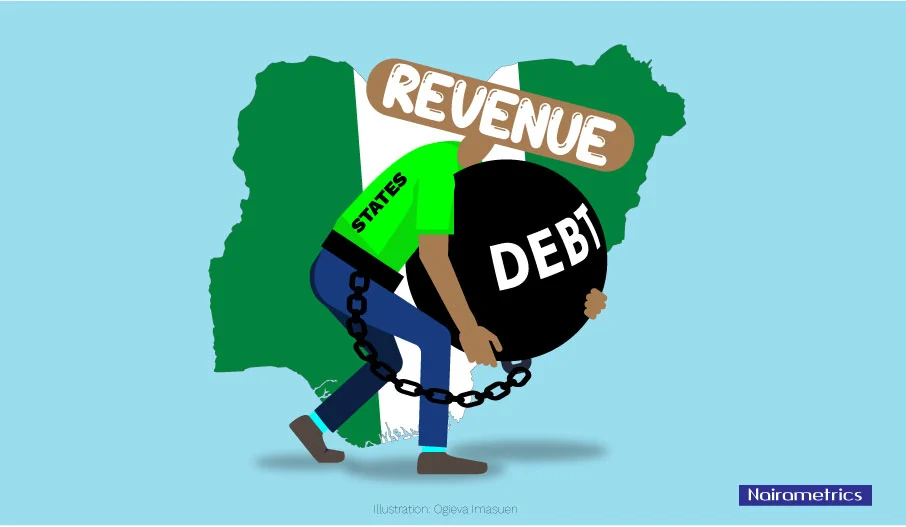
Lagos led other states of the federation with a total domestic debt of N780.48 billion as the total debt of all 36 states, including the federal capital territory hits N4.84 trillion in the first quarter of 2022, representing an 8.6% increase compared to N4.46 trillion recorded as of the previous quarter.
This is according to information released by the Debt Management Office (DMO). On a year-on-year basis, the debt stocks of the states increased by 17.5% compared to N4.12 trillion recorded in the corresponding period of 2021.
A further look at the data shows that Lagos, Ogun, and Rivers States led the list of states with the highest domestic debt stock as of March 2022, jointly accounting for 26% of the total states’ domestic debt profile.
On a broader perspective, Nigeria’s total debt rose by N2.05 trillion in Q1 2022 from N39.56 trillion recorded as of December 2021 to stand at N41.6 trillion.
Ogun State is a distant second with N241.98 billion domestic debt stock, representing 6.1% of the total debts.
READ ALSO: LAGOS: Hausa man mobilizes friends, kills, burns Hausa prostitute he slept with for keeping Quran
Rivers State followed closely in third place with N225.51 billion domestic debt, Imo State recorded a domestic debt stock of N204.61 billion, while Akwa Ibom recorded a domestic debt of N203.11 billion.
Others include Delta (N163.48 billion), Cross River (N158.93 billion), Plateau (N152.1 billion), Bayelsa (N151.41 billion), and Oyo State (N141.19 billion).
The domestic debt stock of Lagos State surged by N273.1 billion from N507.38 billion recorded as of March 2021 to N780.48 billion in March 2022. Also, Ogun State increased its debt stock from N156.34 billion to N241.98 billion in the same period.
Imo State’s domestic debt stock rose from N149.89 billion to N204.61 billion, which represents N54.72 billion increase year-on-year. Oyo and Kwara State grew their debt profile by N49.24 billion and N41.41 billion in one year.
On the other hand, Delta, Rivers, and Akwa Ibom saw their debt profile decrease by N50.3 billion, N41.43 billion, and N29.1 billion respectively.
In terms of percentage change, Sokoto State recorded the highest increase of 66.2% in the space of one year, closely followed by Kawara and Ogun State with 65.5% and 54.8% increase. On the flip side, Abuja recorded a 26.4% decline in its domestic debt stock, followed by Delta (-23.5%), and Rivers State (-15.5%).
The press release by the DMO partly reads: “Whilst the total public debt to GDP at 23.27% was below Nigeria’s self-imposed limit of 40%, the momentum by the government to grow and diversify revenues remains a priority to ensure the public debt is sustainable.
“Initiatives in this regard are yielding results as Actual revenues for January to November 2021 at N5.51 trillion was 39.21% more than the N3.96 trillion recorded in 2020. Similarly, the share of Non-oil revenue grew by 80% compared to 61% in 2020.”


-
 Latest7 days ago
Israel marks 3 years since October 7 Hamas attack amid Gaza strikes, election debate
-

 Energy6 days ago
Fuel Battle: Dangote, marketers and government clash over petrol imports
-
 Energy1 week ago
Petrol, diesel prices rise 86% in 2026 as costs hit fresh highs
-

 Latest1 day ago
Full List: Meet the 2026 Nobel Prize winners across six categories
-

 Football1 week ago
Nigeria’s World Cup exit under spotlight as FIFA’s DR Congo files emerge
-

 Latest1 week ago
US Court set to rule on release of FBI, DEA records on Tinubu
-

 Business1 week ago
Nigerian investors at a crossroads as fixed-income yields slide
-

 Latest1 week ago
Oyo APC crisis deepens as Oluyole reconciliation meeting ends in brawl