
News
PPP crucial in addressing Nigeria’s infrastructure deficit–Osinbajo

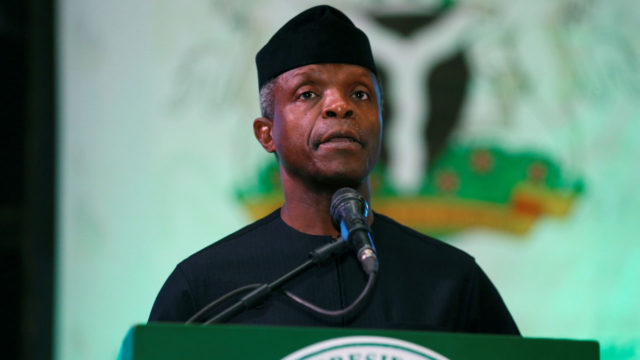
Vice President Yemi Osinbajo says the only way to effectively address the massive infrastructure deficit in Nigeria is by Public-Private Partnership (PPP) arrangement.
Osinbajo’s spokesman, Laolu Akande, in a statement on Thursday in Abuja, said the vice president spoke at the opening ceremony of a 2-day retreat of the National Council on Privatisation (NCP).
The retreat will, among other things, deliberate on the proposed amendment of the Public Enterprises (Privatisation and Commercialisation) Act, 1999.
The vice president said that Nigeria would require at least 2.3 trillion dollars over the next 30 years to bridge the infrastructural gap.
“The review of budgetary allocation for capital expenditure even over the past decade will show that government resources are completely insufficient for this purpose.
“While government can take either commercial or concessionary loans for infrastructure development, this is an additional burden on a usually considerably leveraged balance sheet.’’
He said there was a large pool of investable funds from both local and international investors for the development and maintenance of infrastructure.
Osinbajo said, however, the funds were only accessible where there was a business case to be made for developing public infrastructure.
“So, for both institutional and individual investors, there is far more comfort with lending or with equity participation where a private sector entity partners with a public authority owner of the infrastructure.
“This way the public partner can play its natural role of a regulator (regulation and policy), leaving business to the private sector whose reason for being is business; so, for investors, PPP presents the best of both worlds,” he said.
He urged the participants drawn from the private and public sectors at the retreat to remain focused on the objectives of the meeting,.
According to him, developing a framework that will be attractive to investors should be topmost in their deliberations.
Earlier in his opening remarks, the Director-General of BPE, Mr Alex Okoh, said the current economic environment required government to adopt innovative ways of attracting resources for infrastructure development.
He said an amendment of the BPE Act would among other things expand private sector participation in the Nigerian economy as well as attract more foreign capital to different sectors of the economy.
Dignitaries at the opening session included the Minister of Industry, Trade and Investment, Otunba Niyi Adebayo and the Senate Committee Chairman on Privatisation, Sen. Theodore Orji.
Representatives of the office of the Attorney General of the Federation, Central Bank of Nigeria (CBN), NCP, among others were also at the event.


-

 Latest5 days ago
Full List: Meet the 2026 Nobel Prize winners across six categories
-

 Football5 days ago
Premier League Matchweek 7: Five Fixtures That Could Shape the Weekend
-
 Latest5 days ago
Umahi defends Lagos-Calabar highway route changes amid public outcry
-
 Business4 days ago
Dangote Refinery IPO: 70% Subscription claim meets fourfold demand assertion as investors seek clarity
-
Business4 days ago
Dangote Refinery IPO Extension: Was the 70% subscription report overhyped?
-

 Latest3 days ago
UCTH faces morgue crisis as 50 unclaimed corpses await mass burial
-
 Featured4 days ago
El-Rufai, ADC governorship candidate’s court appearance puts Kaduna opposition politics in focus
-

 Business2 days ago
BREAKING: Nigeria’s Inflation Rate Drops to 14.63% in September