
Politics
REVEALED: Army officers sacked for not supporting APC

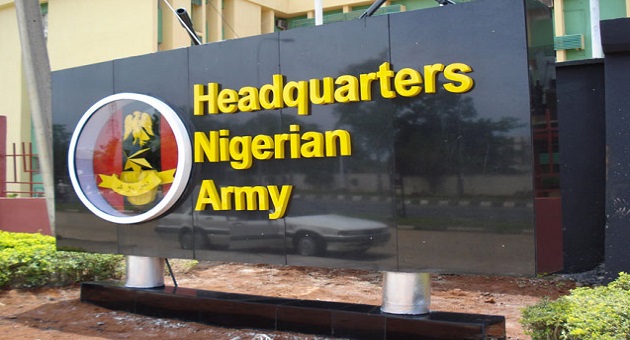
The Nigeria Army has been accused of sacking some of its officers for not showing support for the ruling All Progressives Congress (APC) in the last elections. According to a special investigation, the recently retired officers were sent packing without following proper procedures and for having ties to the erstwhile administration of ex-President Goodluck Jonathan.
While the report confirmed that some officers were found culpable by the ongoing arms scandal probe panel, majority of the soldiers were actually sacked because of their loyalties to the former leader. “Majority of the 38 officers compulsorily retired by the Nigerian Army two months ago were sent away without recourse to the rules of disengagement in the Nigerian military.”
It continued: “…the Army breached its own rule by retiring most of the officers without query or indictment by any panel, thereby raising question of arbitrariness….contrary to the claim by the Army,…investigations showed that only a few of the affected officers were queried, tried and indicted. “Others had their careers abruptly cut short for reasons that smacks of high-level arbitrariness, pettiness, witch-hunting and partisanship by authorities of the Army.”
Army insiders are reported as saying that the affected officers “…were never informed of their offences nor were they invited to face any panel of inquiry,” but it quoted a document saying, they were retired for allegedly committing “serious offence”.
The sources are also quoted as saying that “the remaining 10 officers were simply retirement because they were suspected to have failed to help this regime to power. “For instance, two officers were laid off because of their ties to the embattled former National Security Adviser, Sambo Dasuki….”
ALSO SEE: Niger Delta Republic: Military Commanders converge in Yenagoa
But the army has denied any complicity in the dismissal of the officers. “Those that were compulsorily retired had one problem or the other that warranted their compulsory retirement from the Army. “Basically that’s it. And whoever is not satisfied with that should please seek redress. They are quite familiar with the terms and conditions of service.
“None of them was arbitrarily retired and they know. Army can’t just retire you without any offence or because the Chief of Army Staff does not like your face. “It is not for them to go to newspaper. They were advised to write the Commander-in-Chief through the Chief of Defence Staff to seek redress. Their records are there and they will be given cogent reason why they were asked to retire compulsorily,”
Officers affected are Major-Generals F. O. Alli, E.J. Atewe, I. N. Ijoma, L. C. Ilo, TC Ude, Letam Wiwa, SD Aliyu, M.Y Ibrahim, LC Ilo and O. Ejemai. Also affected are Brigadier-Generals D. M. Onoyeiveta, A. S. O. Mormoni Bashir, A.S.H Sa’ad, A. I. Onibasa, D. Abdusalam, L.M. Bello, KA Essien, B. A. Fiboinumama and I. M. Lawson. Others are Cols. M.A. Suleiman, I. O. Ahhachi, P. E. Ekpenyong, T. T. Minimah, O. U. Nwonkwo, and F. D. Kayode, Lt-Cols C. O. Amadi, K. O. Adimogha, T. E. Arigbe, O. A. Baba Ochankpa, D. B. Dazang, O. C. Egemole, Enemchukwu, A. Mohammed, A. S. Mohammed, G. C. Nyekwu, T. O. Oladintoye, C. K. Ukoha and Major A. T. Williams.













-

 Featured1 week ago
Inside INEC’s race to prepare for Nigeria’s 2027 elections
-
 Featured1 week ago
2027: APC unveils nationwide campaign timetable, Tinubu to rally in 12 states
-

 Business5 days ago
Naira faces exchange rate gap as Dollar hits N1,380 on parallel market
-

 Business1 week ago
Court dismisses ₦170m Trade Fair contract claim, says Zenith Bank was not a party
-

 Latest1 week ago
Breaking: NNPCL raises petrol price to ₦1,405 per litre amid discount controversy
-

 Featured1 week ago
From kitchen to Supreme Court: Nigerian’s fight over alleged support for terrorists
-

 Football1 week ago
Maresca reveals Guardiola’s reaction to Man City’s 4-2 defeat to PSG
-

 Business7 days ago
NCC launches Internet Governance Working Group to tackle AI risks, boost online safety