
Business
NAISU 2026; FRSC pledges robust safety framework for EV, CNG adoption

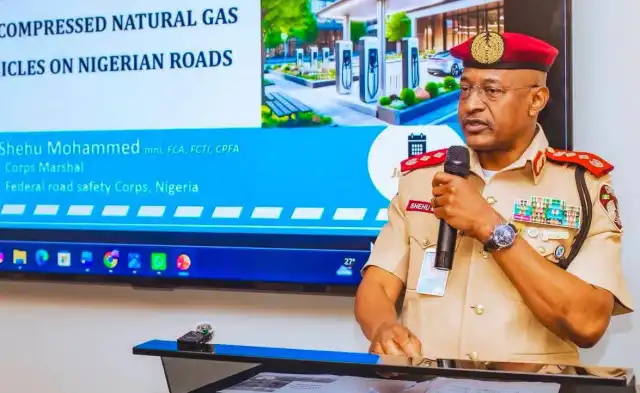
The Federal Road Safety Corps (FRSC) has reaffirmed its commitment to providing the regulatory, safety and enforcement framework needed to support Nigeria’s transition to Electric Vehicles (EVs) and Compressed Natural Gas (CNG) vehicles, describing road safety as central to the success of the Federal Government’s clean mobility agenda.
Corps Marshal Shehu Mohammed made the commitment on Thursday while delivering a keynote address at the 3rd Nigeria Auto Industry Summit (NAISU) held in Lagos.
The summit, organised by the Nigeria Auto Journalists Association (NAJA) in collaboration with the National Automotive Design and Development Council (NADDC), brought together policymakers, regulators, vehicle manufacturers, energy experts and other stakeholders to discuss the future of sustainable transportation in Nigeria.
The event, themed “Nigeria’s Clean Mobility Future: The EV and CNG Journey Under the Bola Tinubu Administration,” focused on strategies for accelerating the country’s shift towards cleaner and more efficient transport systems.
Presenting a paper titled “The Safety of Electric Vehicles (EVs) and Compressed Natural Gas (CNG) Vehicles on Nigerian Roads,” Mohammed said the transportation and energy reforms introduced by President Bola Tinubu’s administration have positioned Nigeria to embrace cleaner, safer and more affordable mobility solutions.
According to him, the widespread adoption of EVs and CNG-powered vehicles would reduce the country’s dependence on conventional fossil fuels, enhance energy security, promote environmental sustainability and stimulate economic growth.
The Corps Marshal, however, stressed that the transition must be supported by a strong safety ecosystem built on effective regulations, technical standards, public awareness and emergency preparedness.
READ ALSO; FRSC opens 2026 nationwide recruitment, online applications begin July 3
He disclosed that the FRSC has aligned its operations with the Federal Government’s clean transportation policy by strengthening vehicle inspection procedures for CNG-powered and converted vehicles, improving emergency response capabilities, enhancing crash reporting through the National Crash Reporting Information System (NACRIS) and expanding nationwide public enlightenment campaigns on the safe use of emerging vehicle technologies.
“These initiatives are aimed at building public confidence while ensuring that the transition to cleaner transportation does not compromise road safety,” he said.
Mohammed also revealed that the Corps is collaborating with key government agencies and industry stakeholders, including the Presidential Initiative on Compressed Natural Gas (Pi-CNG), the National Automotive Design and Development Council (NADDC), the Nigerian Midstream and Downstream Petroleum Regulatory Authority (NMDPRA), the Standards Organisation of Nigeria (SON), the Nigerian Electricity Regulatory Commission (NERC) and the Nigerian Institute of Transport Technology (NITT), to develop a comprehensive national framework for the safe deployment of EVs and CNG vehicles.
According to him, the partnership covers the implementation of the National Gas Vehicle Management System (NGVMS), development of standard operating procedures, coordinated vehicle inspections, emergency response protocols, dedicated registration number plates for EVs and CNG vehicles, structured data sharing and sustained public awareness programmes.
The FRSC boss further highlighted the Corps’ Mobile Application as a digital platform designed to assist motorists in navigating Nigeria’s evolving clean mobility landscape.
He disclosed that the Corps is also supporting the pilot deployment of electric vehicles in Abuja while working with relevant stakeholders to ensure that factory-built and converted CNG vehicles comply with approved national safety standards.
Mohammed emphasised that regular vehicle inspections, certification of conversion centres, specialised training for emergency responders and continuous stakeholder engagement would be critical to ensuring a safe and successful transition to alternative fuel transportation.
While outlining the environmental and economic advantages of EVs and CNG vehicles, the Corps Marshal cautioned that technological innovation must be accompanied by strict adherence to safety standards.
He urged vehicle owners, transport operators, conversion centres and other industry players to comply with approved regulations, stressing that public safety must remain the foundation of Nigeria’s clean mobility drive.
Mohammed also commended President Bola Tinubu for what he described as visionary leadership in advancing Nigeria’s clean energy transition, noting that increased investment in alternative fuel transportation would lower transport costs, strengthen energy security, create employment opportunities, stimulate local automotive manufacturing and position Nigeria among countries leading the shift to sustainable mobility.
He assured stakeholders that the FRSC would continue to provide the technical leadership, regulatory oversight and operational support required to ensure that the Federal Government’s Renewed Hope Agenda on clean transportation delivers lasting economic, environmental and road safety benefits.


-

 Football7 days ago
Banda, Chawinga make 2026 Women’s Ballon d’Or top 30 shortlist
-

 Featured7 days ago
Peter Obi, Makinde and the 2027 elections: Can unity really challenge APC?
-

 Business1 week ago
Nigerian Breweries’ H1 profitability strengthens as revenue hits N804bn
-

 Trending Stories5 days ago
Davido, Wizkid, Burna Boy or Asake: Who is having the biggest 2026 so far?
-

 Business1 week ago
Nigeria records N12.59trn trade surplus in Q2 2026 — NBS
-

 Football5 days ago
Premier League releases 2026/27 festive fixtures, 7 matches set for Boxing Day
-

 Business3 days ago
Jetour Nigeria, dealers take dashing, other models to Abuja Experience
-

 Business4 days ago
Dangote Refinery IPO shifts spotlight to corporate governance, investor protection