
Latest
FG investing billions in social protection to fight poverty-Ngige

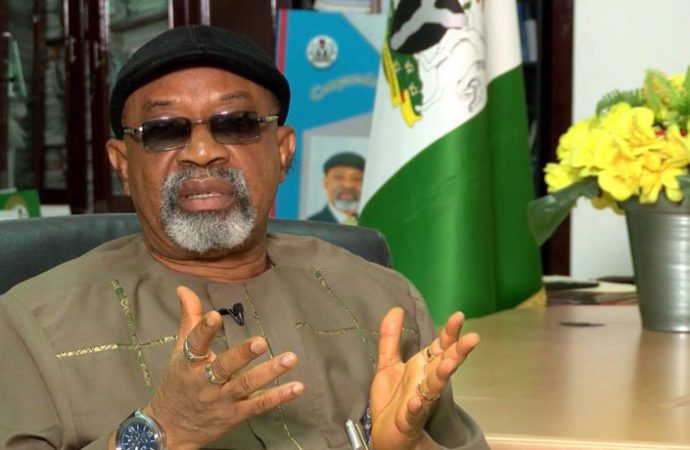
The Federal Government says is investing billions in social protection to fight poverty in the country.
The Minister of Labour and Employment, Sen. Chris Ngige, said this while addressing newsmen on the occasion of the 2022 World Day Against Child Labour, on Thursday in Abuja.
The event was themed; “Universal Social Protection to end Child Labour.”
Ngige however, described the billions of Naira spent by the Federal Government on social protection programs as triple vaccination against poverty.
He said that the Federal Government was vigorously implementing its numerous social protection programs to better the lives of parents and children.
According to him, everything possible is being done to sustain the social protection programs despite Nigeria’s dwindling revenue.
He noted that poverty was fueling child labor, especially in developing countries, but expressed optimism that the scourge could be eliminated through the establishment of social protection floors and programs.
He said that his ministry and other members of the National Steering Committee on the Elimination of Child Labour were calling for increased investment in social protection programs and schemes.
He added that this would establish solid social protection for children from child labor.
He explained that social protection programs were essential in the fight against poverty and vulnerability, identified as the causes of child labor.
“Children engaged in this (child labor) are badly endangered and that is why the government, through the Ministry of Labour and Employment, in collaboration with the ILO and other stakeholders, has been working assiduously.
“They are collaborating to ensure the elimination of Child Labour in line with SDG 8.7, and that young workers of legal working age are protected and work in safe conditions,’’ he said.
According to the minister, the government is vigorously implementing the National Children School Feeding Programme (NCSFP), which is the major plank of the battle to fight child labor.
He said this was aimed at increasing children’s school enrollment and preventing them from dropping out of school.
He said the children were being fed with proteins and nutritious food for healthy growth and also to keep them in school while providing jobs for their parents as farmers, traders, and cooks.
According to Ngige, the government is also investing billions of Naira in Universal Basic Education, which is enabling children to have free primary and junior secondary school education, and curbs child labor.
He said poverty was also being addressed through the conditional cash transfer program, Trader moni, and the N-power program.
Ngige said others were the diversification of the economy into agriculture through Youth Employment in Agriculture Programme (YEAP) and the Technical Education Vocational Training (TVET) scheme.
He said the government has been trying to sustain all these programs despite the declining revenue.
“The Medium Term Expenditure Framework (MTEF) shows that in 2023, if we continue with business as usual, without blocking leakages of oil theft, without functional refineries and removal of oil subsidy, we will have zero capital budget allocation.
“The economy will be prostrate. It is the capital projects aspect of the economy that puts money into production. Every money in recurrent is for consumption.
“It doesn’t create jobs. Our earnings before and now are not the same. It calls for concern,’’ he said.
He called on developed countries and the big corporate organizations in Nigeria to support the fight against child labor in Nigeria through investment in social protection.
Also, Ms. Vanessa Phala, Director, International Labour Organisation (ILO) country office for Nigeria, Ghana, Liberia, and Sierra Leone, described the current situation as very serious.
Phala said recent ILO research, in partnership with UNICEF on the role of “Social Protection in the elimination of child labor, revealed that 1.5 billion children worldwide, aged 0-14, received no family or child benefits.
She also noted that more than 160 million children aged five to 17 years, were still engaged in child labor, and progress had stalled since 2016.









-

 Business1 week ago
Dangote Refinery IPO: 70% Subscription claim meets fourfold demand assertion as investors seek clarity
-

 Featured4 days ago
Inside INEC’s race to prepare for Nigeria’s 2027 elections
-

 Latest6 days ago
UCTH faces morgue crisis as 50 unclaimed corpses await mass burial
-
 Featured4 days ago
2027: APC unveils nationwide campaign timetable, Tinubu to rally in 12 states
-
 Business6 days ago
BREAKING: Nigeria’s Inflation Rate Drops to 14.63% in September
-

 Aviation1 week ago
Germany opens online application route for student, EU Blue Card and other long-stay visas
-
 Business4 days ago
Court dismisses ₦170m Trade Fair contract claim, says Zenith Bank was not a party
-
 Business5 days ago
President Tinubu and the Low Transport Fares Fiasco