
News
Overflowing dumpsite in Ifo sparks health fears, cuts off access to 80 Ogun communities

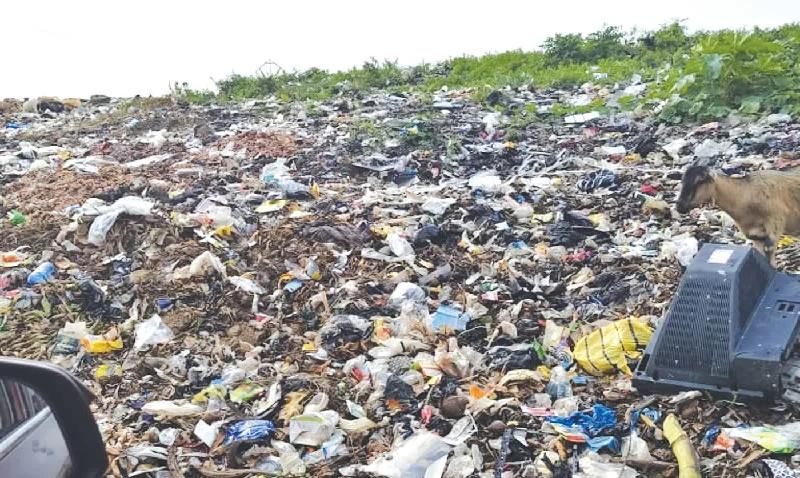
A growing environmental crisis has emerged in the Sholu–Kajola axis of Ifo Local Government Area, where an abandoned and overflowing dumpsite has severely damaged a key access road and raised fears of disease outbreaks across more than 80 surrounding communities.
The dumpsite, located along the busy corridor near Oja Agbe (Farmers’ Market) opposite Akukoku Market, has expanded onto the roadway, turning a once-functional route into a narrow and hazardous passage for commuters and traders.
Residents say the situation has reached a critical stage, with fears of cholera, malaria, and other infectious diseases spreading due to the accumulation of waste, stagnant water, and poor sanitation conditions around the site.
The road, which serves as a major link between the expressway and several rural settlements, is now heavily obstructed by refuse, forcing motorists to navigate through difficult and unsafe sections.
Local residents and business owners describe the area as nearly impassable, with the stench from decomposing waste making movement through the corridor increasingly unbearable.
“This road connects Sholu Road, Kajola Activity Village, and many other communities,” said a local trader, describing the impact on daily movement and commerce. “It has almost been blocked completely, and the smell is terrible.”
Beyond transport disruptions, health concerns have intensified due to the proximity of food vendors to the dumpsite. Open food sales continue within the vicinity of the waste, despite visible presence of flies, rodents, and contaminated runoff.
Community leaders say residents have been forced to contribute personal funds to carry out temporary repairs on the damaged road after repeated calls for government intervention went unanswered.
According to community representatives, officials from relevant Ogun State ministries had previously visited the site and promised remediation efforts, but no significant cleanup operation has since been carried out.
Public health experts warn that the combination of decomposing organic waste and seasonal rainfall could significantly increase the risk of waterborne and vector-borne diseases, including cholera, malaria, and other infections linked to poor sanitation.
They caution that blocked drainage channels and stagnant water pools created by the waste are ideal breeding grounds for mosquitoes, while rodents attracted to food waste may further increase the risk of disease transmission.
The crisis is unfolding amid a wider crackdown on illegal dumping across Ogun State by the Ogun State Waste Management Authority (OGWAMA), which has recently shut down several markets and industrial sites over improper waste disposal practices.
While enforcement actions have intensified in urban centres such as Abeokuta and Sango-Ota, residents of Ifo say their community continues to suffer from neglect despite repeated complaints.
For now, the affected communities remain caught between deteriorating public health conditions and worsening transport isolation, as calls grow for urgent government intervention to clear the dumpsite and restore access to the affected road network.


-

 Latest2 days ago
Pastor Chris Oyakhilome announces mother’s passing at 88 [VIDEO]
-

 Football5 days ago
Saka: England still carry World Cup scar
-

 Comments and Issues1 week ago
Sometimes, goodwill finds us through the people we love
-

 Latest3 days ago
Arsenal eye €70-80m move for Real Madrid star
-

 Business6 days ago
CBN reduces MPR by 350bps to 23% in major monetary policy shift
-

 Latest2 days ago
How adulterated palm oil, coloured pepper are putting consumers at risk
-

 Crime3 days ago
Police arrest suspect, launch manhunt for 2 others over Delta Education Director’s death
-

 Crime2 days ago
Deaths in NSCDC Custody: Can Nigeria guarantee the safety of detainees?