
Latest
EU planning to send more migrants back to home countries

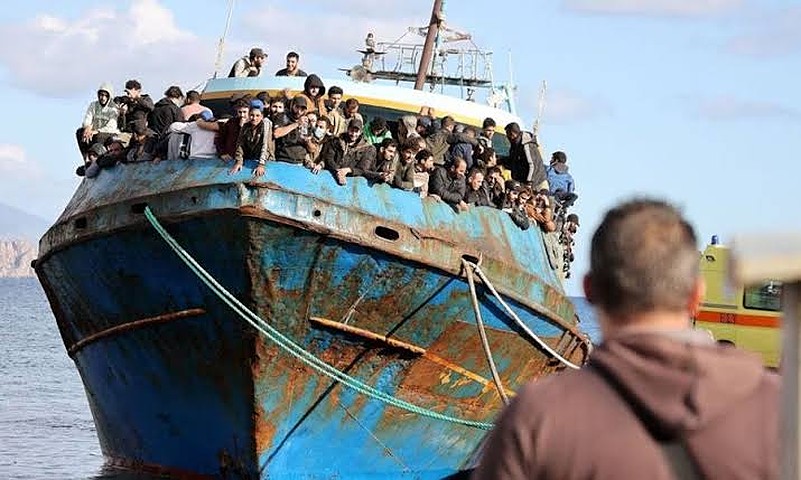
The European Union migration ministers met on Thursday to discuss visa restrictions and better coordination inside the bloc.
The meeting focused on ways to be able to send more people with no right to asylum in Europe back to their home countries including Iraq.
Three years after the 27-nation EU agreed to restrict visas for countries deemed failing to cooperate on taking their people back, only Gambia had been formally punished.
The EU’s executive European Commission proposed similar steps vis-a-vis Iraq, Senegal and Bangladesh, though two EU officials said cooperation with Dhaka on returning people has since improved.
Still, the EU’s overall rate of effective returns stood at 21 per cent in 2021, according to Eurostat data, the latest available.
One of the EU officials said “that is a level that member states consider unacceptably low.
“Immigration is a highly politically sensitive topic in the bloc where member countries would much rather discuss stepping up returns, as well as reducing irregular immigration in the first place.
“It will be better than to revive their bitter feuds over how to share out the task of caring for those who make it to Europe and win the right to stay.’’
The commission said in a discussion paper for the ministers, which was seen by Reuters that “establishing an effective and common EU system for returns is a central pillar of well-functioning and credible migration and asylum systems.’’
Some 160,000 people made it across the Mediterranean in 2022, according to U.N. data, the main route to Europe for people fleeing wars and poverty in the Middle East, Africa and Southeast Asia.
On top of that, nearly 8 million Ukrainian refugees were also registered across Europe.
The ministers meet two weeks before the 27 EU national leaders gather in Brussels to discuss migration, and are also expected to call to send more people away.
“Swift action is needed to ensure effective returns from the European Union to countries of origin using as leverage all relevant EU policies,” read a draft of their joint statement, which was also seen by Reuters.
Inside the EU, however, there is insufficient resources and coordination between different parts of government to ensure each a person with no right to stay is effectively returned or deported, according to the Commission.
“Insufficient cooperation of countries of origin is an additional challenge,” it added, naming problems including recognising and issuing identity and travel documents.
However, pressure from migration chiefs to punish some third countries with visa restrictions has in the past run against the EU’s own foreign and development ministers, or failed due to conflicting agendas of various EU countries.
There had therefore, not been enough majority among EU countries so far to punish another country apart from Gambia, where people can no longer get multiple entry visas to the bloc and face a longer wait.
While EU countries including Austria and Hungary loudly protest against the mainly-Muslim, irregular immigration from the Middle East and North Africa, Germany is among those seeking to open up their job market to much-needed workers from outside the bloc.











-

 Business3 days ago
OPay explains how Nigerians can access FG’s N50,000 monthly cash relief
-

 Sports1 week ago
Senegal opens Dakar 2026 Youth Olympic Games, Africa’s first Olympic event
-

 Latest7 days ago
FG Announces N50,000 cash support for vulnerable Nigerians under new relief programme
-

 Business7 days ago
NNPC’s N66-per-litre petrol discount set to end October 31
-

 Latest7 days ago
INEC recognises Pantami for Gombe, keeps Kano NDC candidate off final list
-

 Latest1 week ago
Netanyahu, Eisenkot face coalition deadlock as Israel struggles to form new government
-

 Latest7 days ago
NDC Chieftain tells Atiku to drop presidential ambition over son’s support for Tinubu
-

 Crime7 days ago
Doris Ogala remanded as Court adjourns bail hearing to November 6