
Latest
Lagos solar panel controversy deepens as state explains approval rules for estates

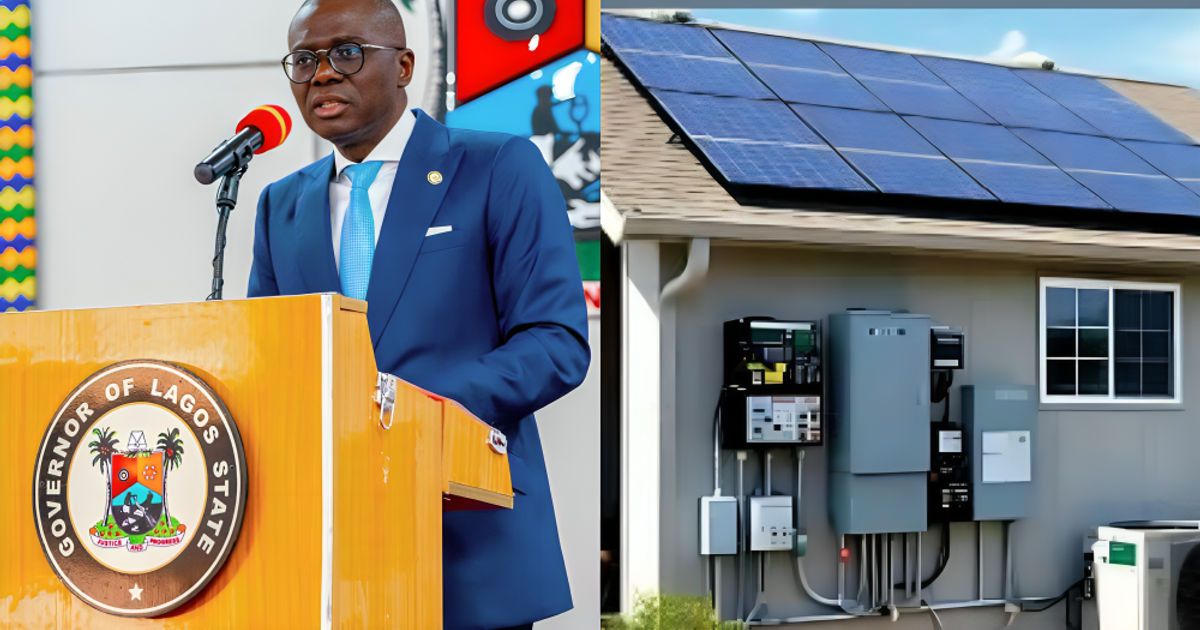
A viral video showing officials of the Lagos State Ministry of Housing confronting a resident over the installation of solar panels on his home has triggered widespread public backlash and heated debate across the state.
In the video, officials from the ministry’s monitoring and compliance unit were seen questioning the homeowner and insisting that approval and payment of administrative fees were required before solar installations could proceed.
The footage quickly spread across social media, drawing mixed reactions from residents who expressed anger over what they perceived as an attempt by government to impose additional financial burdens on citizens already grappling with economic hardship.
In response to the controversy, the Lagos State Government clarified that permits and associated administrative fees for solar energy installations do not apply to private homeowners or tenants across the state.
According to the government, the requirement is strictly limited to residents of government-owned social housing estates.
The clarification was issued by Wale Ajetunmobi, who said the resident featured in the viral video misunderstood the policy.
Ajetunmobi explained in an X post that only occupants of social housing estates managed by the state are required to seek approval before making structural alterations, including solar installations.
“This development is true, but the man who made the video seems to be misinformed about the Lagos State Government’s guidelines for installing solar energy systems in social housing estates,” he said.
He further explained that the policy exists because the government serves as facility manager for those estates, where solar installations are often considered structural modifications that may affect shared infrastructure.
“Only residents living in government-owned social housing estates are charged administrative fees for alterations, such as the installation of a solar power system, before any additional development can be permitted,” he said.
READ ALSO: US-based Nigerian introduces electric, solar-powered cars into Nigeria, Africa
He added that any such modification must pass through the Ministry of Housing’s physical planning and survey departments for approval, compliance checks and post-installation inspection.
According to him, the officials seen in the video were acting within their mandate during a routine monitoring exercise and the resident had commenced installation without prior approval.
Ajetunmobi stressed that the policy is not a general levy on solar energy use in Lagos State, but a facility management requirement tied to government-owned properties.
He also noted that tenants in social housing estates typically sign indemnity agreements outlining conditions for alterations and shared responsibility for estate infrastructure.
The government maintained that unapproved structural changes could expose it to liability risks, including damage to roofs and fire incidents affecting other occupants.
Despite the clarification, the issue has continued to generate intense public debate, with many residents interpreting the initial video as evidence of broader attempts to regulate or tax private solar energy use.
Critics argue that even the perception of such a policy could discourage adoption of renewable energy in a country still struggling with persistent electricity shortages.
Others described the controversy as symptomatic of deeper frustrations over governance, taxation and the rising cost of living in Lagos State.
Some residents insist the matter reflects a broader pattern of increasing levies and administrative charges, while others claim it highlights the absence of adequate public infrastructure.
Prominent voices among residents and commentators have also condemned what they see as excessive regulation of basic survival alternatives.
A businessman in the Amuwo Odofin area, Anthony Osewele, criticised the idea of charging residents for solar installations, describing it as inappropriate and unjustifiable.
He argued that solar energy, derived from sunlight, should not be subject to government fees, especially in a context where public electricity supply remains unreliable.
A legal practitioner, Marcellus Onah, also said residents were being forced into self-help solutions due to failures in public infrastructure, particularly electricity supply.
An estate agent, Rowland Adebayo, added that residents were already burdened by multiple taxes and levies, warning that additional charges could deepen public resentment.
Under the Lagos State Urban and Regional Planning and Development framework, structural modifications to buildings generally require approval from relevant authorities, particularly in government-managed estates.
However, the controversy has shifted beyond legal interpretations into broader questions about energy access, affordability, and the role of government in enabling or regulating alternative power solutions.
For many residents, solar energy represents a lifeline amid chronic electricity shortages, and any perception of additional costs is seen as a barrier to energy independence.


-

 Latest5 days ago
Full List: Meet the 2026 Nobel Prize winners across six categories
-

 Football5 days ago
Premier League Matchweek 7: Five Fixtures That Could Shape the Weekend
-

 Latest4 days ago
Umahi defends Lagos-Calabar highway route changes amid public outcry
-

 Business3 days ago
Dangote Refinery IPO: 70% Subscription claim meets fourfold demand assertion as investors seek clarity
-
Business4 days ago
Dangote Refinery IPO Extension: Was the 70% subscription report overhyped?
-

 Latest2 days ago
UCTH faces morgue crisis as 50 unclaimed corpses await mass burial
-

 Featured4 days ago
El-Rufai, ADC governorship candidate’s court appearance puts Kaduna opposition politics in focus
-

 Business2 days ago
BREAKING: Nigeria’s Inflation Rate Drops to 14.63% in September