
Features
NTSB blames pilot error “spatial disorientation” for Herbert Wigwe helicopter crash
The United States National Transportation Safety Board has attributed the helicopter crash that killed former Access Holdings CEO, Herbert Wigwe, his wife, son, and three others to pilot error caused by spatial disorientation

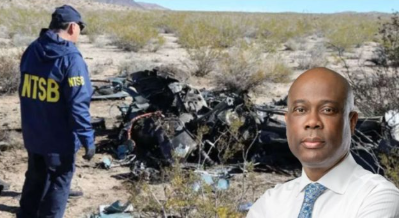
The United States National Transportation Safety Board (NTSB) has concluded that pilot error, stemming from spatial disorientation, was the probable cause of the helicopter crash that tragically killed former Access Holdings CEO, Herbert Wigwe, his wife, son, and three others in February 2024.
The NTSB report, released on Wednesday in the US, further implicated the helicopter company, accusing it of “inadequate oversight of its safety management processes.
The final report from the NTSB unraveling the reasons behind the February 9, 2024, crash near the California-Nevada border stated that the helicopter, registered as N130CZ, was operating under visual flight rules but encountered instrument meteorological conditions, which necessitate different flight protocols and instrumentation. The preliminary report had earlier indicated this shift in weather conditions.
According to the NTSB’s findings, investigators determined the “probable cause of this accident to be: the pilot’s decision to continue the visual flight rules flight into instrument meteorological conditions, which resulted in the pilot’s spatial disorientation and loss of control.”
The crash tragically claimed the lives of all six individuals on board, including prominent Nigerian businessman Herbert Wigwe, his wife Doreen, their son Chizi, and Abimbola Ogunbanjo, the former group chairman of Nigerian Exchange Group Plc.
The US accident investigators further revealed significant safety lapses by the helicopter company.
The report stated that the company failed to ensure that pilots properly completed flight risk analyses, adequately recorded maintenance issues, and adhered to required regulations before commencing flights.
“The pilot likely experienced spatial disorientation while maneuvering the helicopter in IMC [instrument meteorological conditions], which led to his loss of helicopter control and the resulting collision with terrain,” the report detailed.
ALSO READ : Group raises alarm over drug abuse among workers, seeks workplace policies
A critical finding of the investigation was that the helicopter’s radar altimeter, a crucial instrument for determining altitude above ground level, was non-functional prior to the fatal flight.
The report disclosed that during a preceding flight, the pilot had communicated via text message with the maintenance director regarding an issue with this vital instrument.
The NTSB report further stated, “A company mechanic performed some troubleshooting on the radar altimeter; however, he was unable to rectify the issue, and the radar altimeter remained non-functional. The mechanic reported that the pilot and the DOM [director of maintenance] were aware that the radar altimeter was not functioning, yet they departed at 1822 on the positioning flight to pick up the passengers.”
The investigation also revealed that despite communication between the pilot and the flight follower after arriving to collect the charter passengers, the “status of the radar altimeter or weather conditions” were not discussed.













-

 Featured1 day ago
BREAKING NEWS: Shouts of joy rock the world as Pastor Chris opens final Healing Streams edition for 2026
-

 Business5 days ago
Naira faces exchange rate gap as Dollar hits N1,380 on parallel market
-

 Football2 days ago
Man United shortlist Emery, Nagelsmann as potential replacements for Carrick
-

 Business2 days ago
Hoodlums raid JED Benue office, abduct 10 staff over power dispute
-

 Football2 days ago
Aston Villa ready to freeze out Garnacho to avoid £43m Chelsea transfer
-

 Business1 week ago
NCC launches Internet Governance Working Group to tackle AI risks, boost online safety
-

 Business2 days ago
EV adoption: Roxettes seeks cheaper financing, local manufacturing incentives
-

 Latest2 days ago
Akpabio tasks Tompolo-backed movement with spreading Tinubu’s renewed hope message