
Latest
Court dismisses suit seeking to stop general elections over exclusion of Nigerians in Diaspora

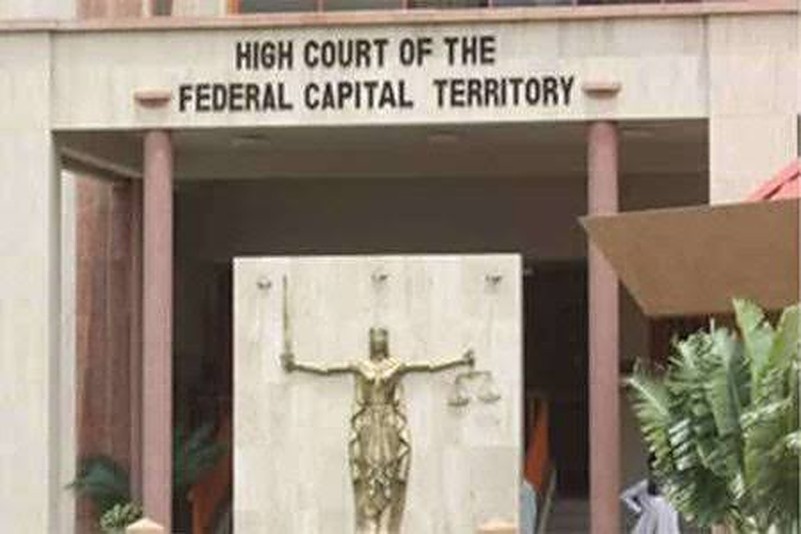
A Federal High Court, Abuja, on Wednesday, dismissed a suit seeking to stop the forthcoming general elections over the exclusion of eligible Nigerians living abroad.
Justice Inyang Ekwo, in a judgment, held that the existing law in the country did not guarantee the right of Nigerians in the Diaspora to vote in any election, hence, the suit lacked merit.
Justice Ekwo said that where a right was not provided for in the constitution, there was no need to enforce that law.
According to him, where there is no law on an issue, there is no issue of question of law on it.
He said it was the duty of those affected by the issue to engage the legislature do that a law is enacted to resolve their issue.
“The court does not enact laws. It cannot also expand the law in order to accommodate an issue before it no matter how sympathetic or humanitarian the cause or situation is.
“It only interprets and expounds the laws, and, it is the law as stated before in this judgment, that when interpreting the provisions of a statue, the court must not ascribe meanings to clear, plain and unambiguous provisions in order to make such provisions conform to the court’s view of their meanings or what they ought to be,” he said.
The judge said by the provisions of Sections 77 (2) and 117 (2) of the 1999 Constitution (as amended), “the right to vote is reserved for every citizen of Nigeria, who has attained the age of 18 years residing in Nigeria at the time of registration of voters for the purpose of election to a legislative house, shall be entitled to be registered as a voter for that election.
“The right to vote for a president or governor is tied to the right to vote in an election of any legislative house, going by the provisions of Sections 132 (5) and 178 (5) of the 1999 Constitution (as amended),” he said.
Justice Ekwo further said that though the applicants were praying the court to declare that Nigerians in diaspora were entitled to vote in the forthcoming elections, he said it was the phrase “residing in Nigeria” in the provisions of the constitution that had challenged and indeed, removed the foundation of their case.
Besides, he observed that their application was only filed on Nov. 9, 2022 at the eleventh hour to the general elections.
“The applicants can only be commended for bringing this matter to the fore.
“However, the court is not where the solution lies for now.
“What this case has revealed is that there is lacuna in the existing law with respect to the right of Nigerians in diaspora to votes in elections in Nigeria.
“The lacuna here is not such that the court can fill by pronouncement or by importing statutory provisions from anywhere.
“There is a situation whose solution is by legislative and not judicial process,” he said.
Justice Ekwo, consequently, dismissed the suit for lacking in merit.
The News Agency of Nigeria reports that Nigerians of voting age living in the diaspora had filed the suit to enforce their fundamental rights to vote in the 2023 general elections.
NAN reports that two plaintiffs: Mr Chikwe Nkemnacho and Mr Kenneth Azubuike Nkemnacho, on behalf of Nigerians in the Diaspora, had filed the suit.
In the suit marked: FHC/ABJ/CS/2119/2022 dated Oct. 31 and filed Nov. 9 by their lawyer, Augustine Temfeh-Nkemnacho, the plaintiffs sued the Independent National Electoral Commission (INEC) and its chairman, Prof Mahmood Yakubu.
Also joined in the suit were President Muhammadu Buhari and the Federal Republic of Nigeria as 1st to 4th respondents respectively.
The plaintiffs were asking the court to stop INEC from proceeding further with the 2023 electioneering process until the commission’s voter register and bio-data base were updated to accommodate them as registered voters.
They prayed the court to declare that they were entitled to participate in the electoral process by being registered to vote in 2023 and in all elections wherever they were domiciled worldwide in line with Sections 13, 14, 42 and 17 of the 1999 Constitution.
They also sought another declaration by the court to the effect that there is still sufficient time for INEC to comply with provisions of Sections 13, 14 and 15 of the 1999 Constitution.
The plaintiffs canvassed that unless they were allowed to vote in the 2023 elections and subsequent ones, their fundamental rights as enshrined in the 1999 Constitution would be grossly violated.
Source – NAN









-
 Latest1 week ago
Global excitement builds as Healing Streams Live Services returns October 23
-
 Featured7 days ago
Inside INEC’s race to prepare for Nigeria’s 2027 elections
-

 Business1 week ago
President Tinubu and the Low Transport Fares Fiasco
-
 Featured7 days ago
2027: APC unveils nationwide campaign timetable, Tinubu to rally in 12 states
-

 Business4 days ago
Naira faces exchange rate gap as Dollar hits N1,380 on parallel market
-

 Business7 days ago
Court dismisses ₦170m Trade Fair contract claim, says Zenith Bank was not a party
-

 Latest7 days ago
Breaking: NNPCL raises petrol price to ₦1,405 per litre amid discount controversy
-

 Business1 week ago
Rite Foods targets beverage market growth with LIDA Malt